
Trees for the forest
seeing the smallest to understand the largest
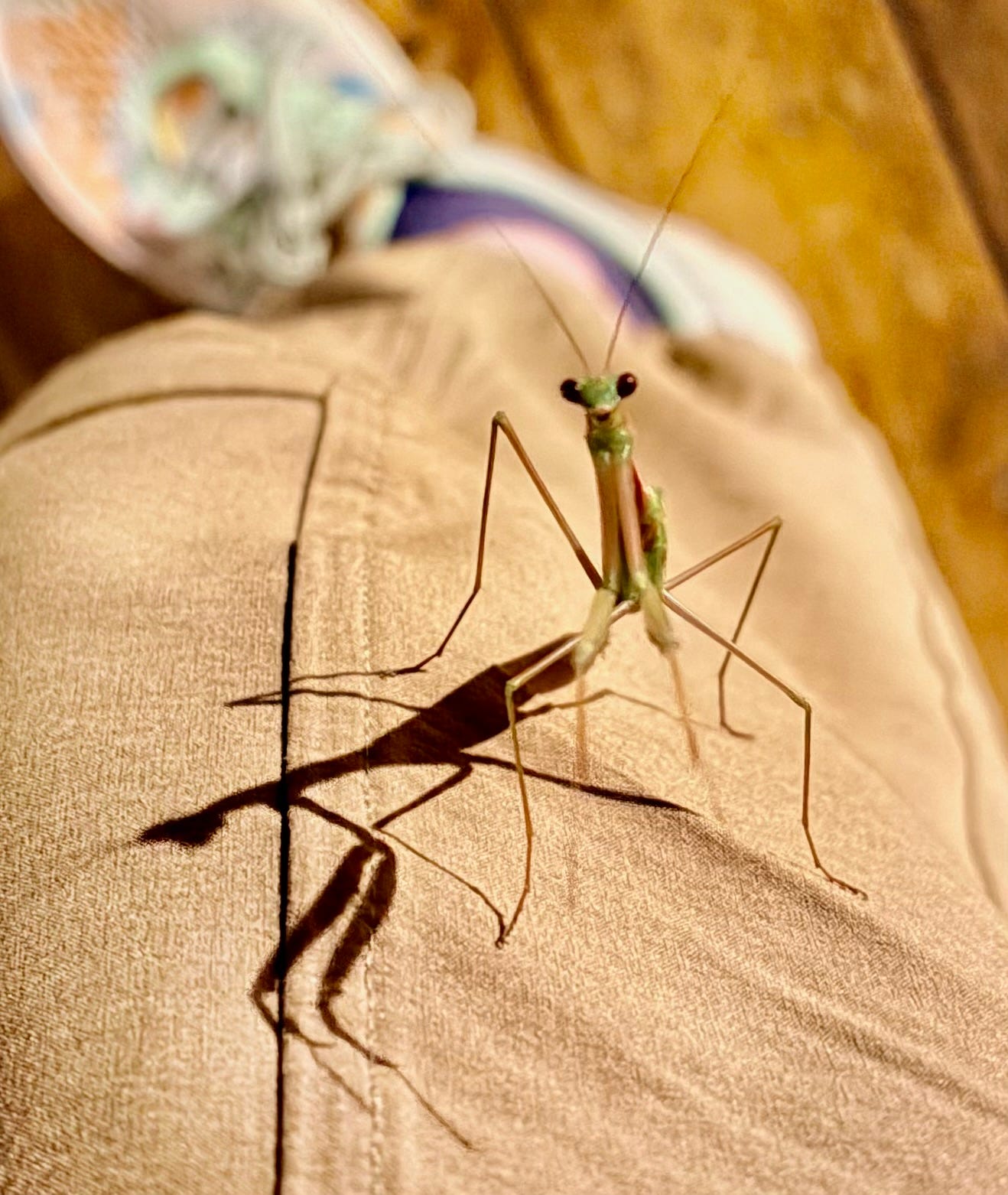
One of the aspects of traveling I adore is how the gifts we walk away with aren’t the ones we anticipated going in. So illustrative of life.
I am returned home from five weeks in Africa, still synthesizing her potent and intoxicating alchemy, and reflecting recurrently about something transformative I didn’t at all foresee: binoculars.
If you’re not a well-equipped birder, you—like me—have probably never peered through the lenses of a top-quality set of field glasses. (They’re not cheap!) Until this trip, my only experiences with binoculars have been absurdly frustrating ordeals involving winking into misaligned lenses, losing the blurry object of my affection long before I can focus the wheel into any resemblance of clarity.
Even when I was able to get objects in focus, the lighting and colors never did justice to nature’s artistry.
So there I am in early February, enfolded by the sacred expanse of Botswana’s Okavango Delta, staring upward with my naked eye at a brown snake eagle roosting high on a bare branch. I observe from afar that she’s a robust and riveting raptor, brown-feathered with yellow eyes and a barred-and-banded tail.
Yet I don’t comprehend how much all of this is actually true until our exceptional guide earnestly places his first-rate binoculars in my hands.
With the slight turn of a precisely responsive focus wheel, I can suddenly see this lofty creature. Really see her…in exquisitely fine detail. And her beauty is arresting. Like so much else on this extraordinary planet, she is a marvel of miraculous micro-art.
The golden glow of her gaze sears my senses, as she attentively surveys the honey-hued landscape for predator and prey. A whiff of wind tousles the fluffy feathers crowning her head, softening her severity. Both the size and steadfast grip of her feet and long talons astonish me, as do the elegantly spectral palettes of browns intricately woven through her cape of glossy feathers like fanciful embroidery.
I could have stared as long as the light let me. And in those magnified moments, I realized just how much of her trueness had nearly escaped me.
Everything changes with clear sight.
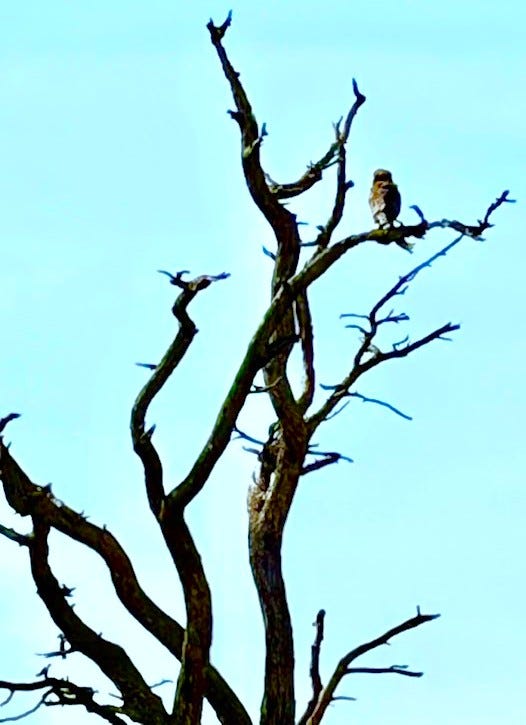
A high resolution perspective that doesn’t negate the importance of the long view. It’s easy in our oft divided world to become near-sighted instead of clear-sighted, allowing the larger picture to be obstructed and even obliterated by myopia.
A wider lens can be truly informative, if not radically reconstructive.
But while it is easy to lose sight of the forest for the trees, the opposite can be true as well. And equally detrimental.
Because what is a forest if not the trees?
The wholly unique—yet intimately interrelated—living and breathing individuals who comprise every forest on Earth with their tender green shoots and youthful yearnings.
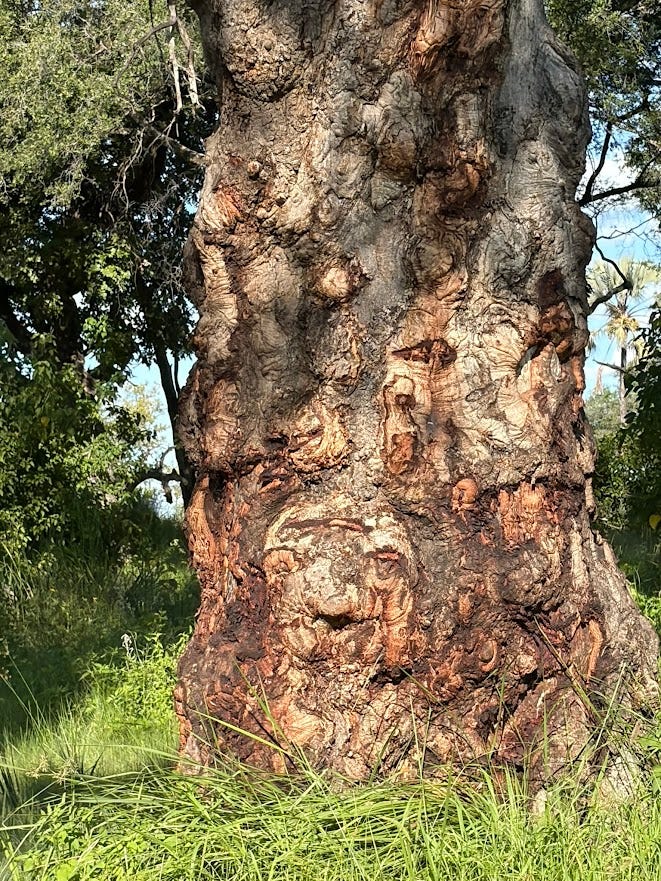
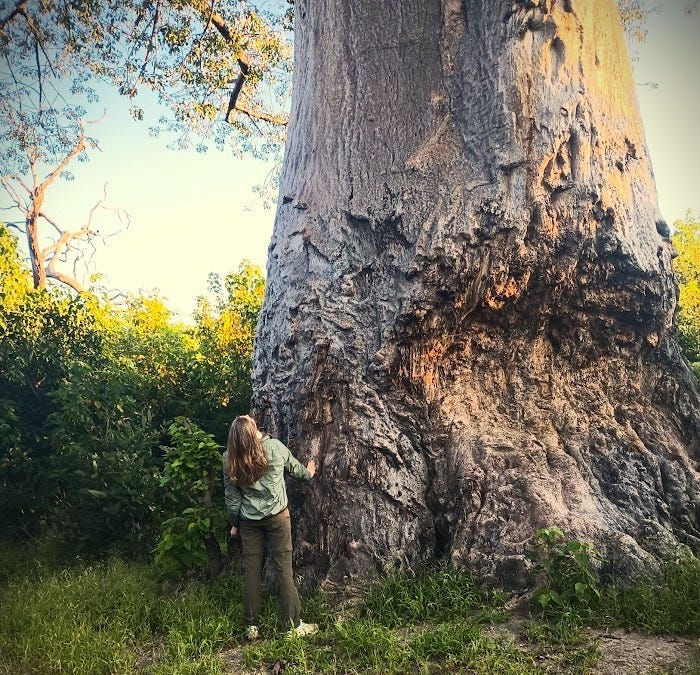
Steadfast elders minding and mending through mighty mycorrhizae. Caverns and nesting nooks. Awnings of birdsong in every weather theme harmonizing with the hum of insect troves to nourish the many. And in the case of the African marula tree: swirling orange burls formed by tannins after elephants peel their bark, sealing themselves off from disease via a fantastical pattern of faces and spaces.
Life is the infinitesimal. And the infinitesimal gather to form the infinite.
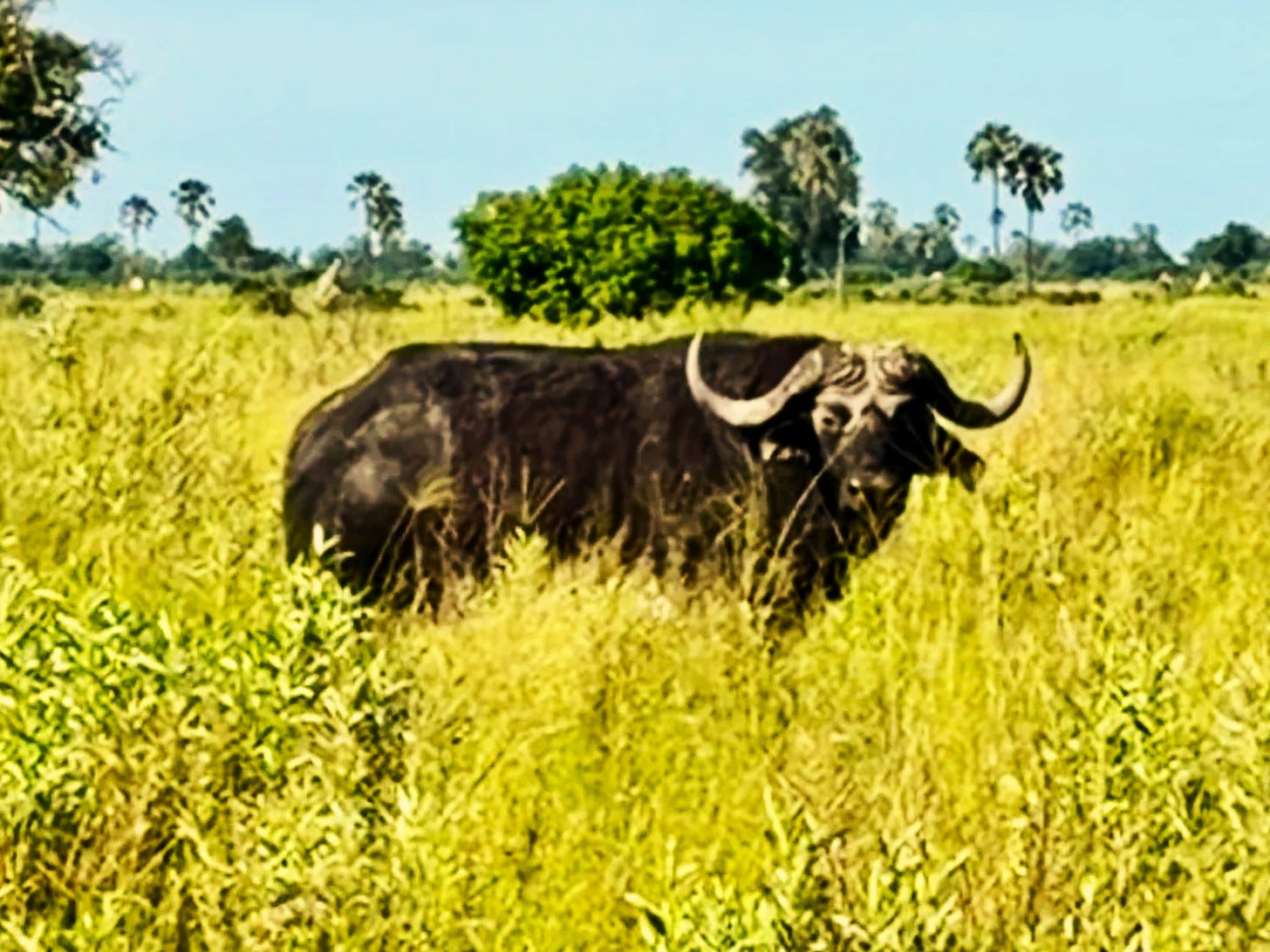
One of the untold dazzling animal species I fell in love with in Africa is the cape buffalo (don’t miss the close-up photos in this link which far outshine my own)—formidable as they were elusive in this particular area of the delta.
Forged of keratin and bone, their iconic curved horns grow down and out before hooking skyward, fusing in mature bulls at the center of their large foreheads—creating a bony shield, or monobrow, appropriately called a “boss.” Bold as they can be, most of our cape buffalo “sightings” were shy snatches of dark horn tips seen poking above undulating yellow thatching and finger grasses, or protruding briefly from behind a bluebush.
One morning at sunrise, we were ambling in a safari jeep through a field of vividly fragrant wild sage and spotted a sizable herd (aka an obstinacy) of cape buffalo grazing placidly at a distance. Like hyenas and elephants, they are matriarchal—led by a single female with trusted life experience, although it’s been studied that she consults the collective about migratory decisions in an inspiring display of democratic consensus.
Here before us stood a stalwart matriarch with her extended family of sisters and aunties, grandmothers and mothers doting on babes; and, yes, a few massive bulls with mighty bosses stately holding court on the periphery.
Our perceptive guide gently placed his premium binoculars in my hands to prismatically eliminate the gap that separated us and them.
How do I describe what happened next? It changed my life, as clear sight can.
A sea of Syncerus caffer scattered across the grassland, no two craggy countenances alike. Velveteen ears, frayed and fringed, drooping yet poised inquisitively. Whiskered nostrils wet with quivering exhalations, morning dew, and remnants of fresh grass tendrils caught on their lips. And oh those nutbrown eyes, deep-set and framed by occasional tufts of white, gleaming with expression and portraits of pure personality. Wild and watchful. Soft and self-aware. Lit up by sentience and soul.
Each face holding a story of the world I wanted to imbibe, and carry home to you my beloved readers.
Born like us to traverse the rustling reed beds, perennial swamps, and perilous sand traps of life on earth, under the very same stars. Alive in their memories, and precious bodies, old and young.
And I did feel it, in my heart, how it pertained to everything (thank you Mary Oliver, see her full poem below). That when I take the time to look, and really see, I am them and they are me.
The Swan

Did you too see it, drifting, all night, on the black river?
Did you see it in the morning, rising into the silvery air -
An armful of white blossoms,
A perfect commotion of silk and linen as it leaned
into the bondage of its wings; a snowbank, a bank of lilies,
Biting the air with its black beak?
Did you hear it, fluting and whistling
A shrill dark music - like the rain pelting the trees - like a waterfall
Knifing down the black ledges?
And did you see it, finally, just under the clouds -
A white cross Streaming across the sky, its feet
Like black leaves, its wings Like the stretching light of the river?
And did you feel it, in your heart, how it pertained to everything?
And have you too finally figured out what beauty is for?
And have you changed your life?
~ Mary Oliver
Thank you for sharing the beauty of life you witnessed in your travels, and the connection of all of us!
What beautifully written recount of your experience! I would love to visit Africa one day and bird there! ✨